
There are three Simms below Hewitt height in the Yorkshire Dales.
The only one I can claim at present is High Green Field Knott (1979ft). It’s north of Pen-y-Ghent but alas has none of its allure. I combined its ascent with a re-visit to the Hewitt of Plover Hill in late February 2026 and a report appears below.
A broad and boggy ‘ridge’ runs from High Green Field Knott six miles or so to the Hewitt of Birks Fell. Halfway there is the Simm of Horse Head Moor (1999ft), which I thought I had climbed with Dave Travers on the second of my two walks to Grassington in 2009. Alas we went to the trig point, a mile from the true summit, so I’ll pay the latter a visit I’m next up in the Dales. I’ll combine it with a trip to Little Whernside (1985ft), about three miles north-east of the Hewitt Great Whernside.
Extending the Hewitts to the Simms also gives me an excuse to revisit the lovely Howgills. Arant Haw (1985ft) is barely a quarter-mile from the descent route I took with my son Adrian after our Howgills wild camp in 2023; annoying. In the north of the range is Green Bell (1985ft), above Ravenstonedale. Whether I take these in one long walk or two short ones I have not yet decided.
Wednesday 26 February 2026: High Green Field Knott and Plover Hill, 13 miles.
Staying near Malham for a few days, I had one day off for “proper walking”. High Green Field Knott was the nearest Simm, and I thought of combining it with a revisit to the Hewitt Plover Hill.
Though it seems HGFK is more often climbed from Halton Gill in Littondale, an approach from Horton-in-Ribblesdale is practical too, if a little longer. My son Adrian, based in Shipley, wanted to join me, so that meant we could both catch the same morning train, myself from Gargrave.
Alas we hadn’t picked the best weather day. Cloud lowered all the time, with frequent showers in the afternoon. But there could be many worse days in late February.
It’s an easy enough start by the Pennine Way, until it turns left after three miles. From here a good enough track leads towards forestry. There are now a couple of options: either skirt the forestry on untracked access land, or continue through it and look for an exit. We chose the latter.
A forestry track soon heads right off the right-of-way, and in turn it’s not before a stream-bed acts as firebreak. The bed itself would not be much fun but its left-hand side bears an old wall and, occasionally, signs of other human footprints. Where it leaves the forest, the fence is replaced by a wooden hurdle, so it’s clear this is a semi-official way up.
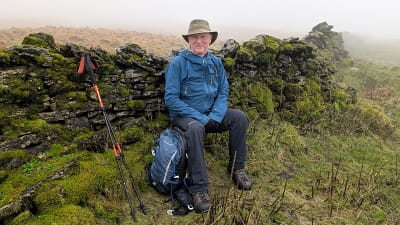
Author at the wall near the high point of HGFK
We headed up to the cairn at spot height 588m and then stuck close to the wall, not bothering with the trig point. It’s half a mile along the flat top to the official high point, which is unmarked and a little way beyond the 602m spot height.
So far, so straightforward, more or less, but I wanted to head over to Plover Hill. Officially this Hewitt was a ‘tick’ following the second (2009) of my two walks to Grassington – I’d recalled passing a prominent cairn.
But something nagged at me, and checking the Hill Bagging database made it clear that I hadn’t passed the high point after all. Better be ethical than have this on my conscience, even though my official claim for the Hewitts was made eight months before.
But it’s no easy matter to cross from one hill to the other. Down is OK, just head by a fence to a copse. The right turn, on a SW bearing towards a second copse, starts OK but paths and a quad bike track peter out. So spying a thin path heading S, I give it a try, but this starts moving SE, and I’m left with pathless boggy ground. Adrian is not too impressed.
Eventually we reach the Littondale – Ribblesdale bridleway, then it’s straight up to the Plover Hill plateau.
There’s one odd thing about the top of Plover Hill, the drystone walls. They are robust, unbroken and the height of a man. As we climbed, we were between a pair of them. Surely there would be a gate or stile at their apex? No. But they could be scrambled, carefully. I then had to scramble another, to get to the side where the true summit lay.
Descent is by a reversal of the Dave walk, straightforward enough even if mucky on top. We had, thankfully, time in Horton’s Crown Inn for me to echo my father’s gesture in 1972 and buy my son something to eat and drink. I hope he remembers.
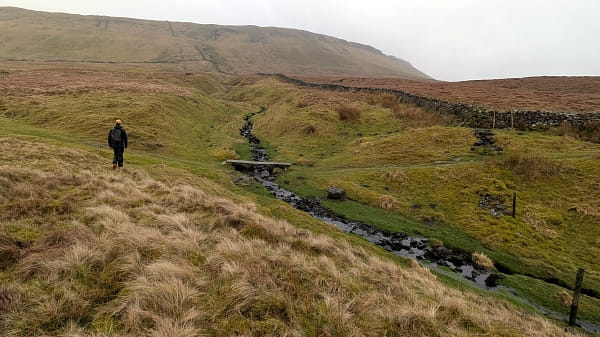
Adrian on the ascent of Plover Hill
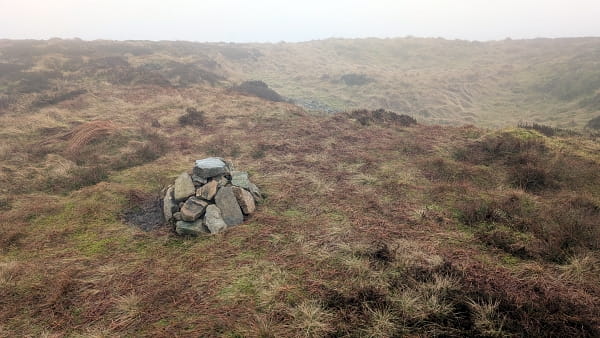
Plover Hill top