
Chalk dominates at the start and end of this section – first, the continuation of the Thanet coast, then later the famous White Cliffs of Dover.
In between there’s a patch of industry, the fascinating small town of Sandwich, some creek-walking, and then a long straight stretch beside the shingle beach either side of Deal. So plenty of variety; some better than others, no doubt, but there’s something weird in the long-distance walker about me that rendered the bit with the worst weather the most enjoyable.
For me, the first stage pre-dated the creation of the England Coast Path, but I remember it well enough to know that we cannot have deviated from its present route.
Sunday 30 April 2006. Broadstairs to Margate, six miles.
We were having a cheeky weekend in a B&B in Broadstairs.
I’d always wanted to go back, as here or Margate is where I spent my infant holidays, and thus have my very earliest memories – getting separated from mum and dad on Broadstairs beach among them, until a kindly soul returned me to my frantic mother.
The walk itself is probably the best single piece of Thanet coast walking, with a swing round from north to west as North Foreland is rounded. (This was a section taken anti-clockwise, rather than my general direction of travel round the Kent coast.)
Broadstairs itself certainly retains a classier feel than its larger neighbours Margate and Ramsgate. There are Charles Dickens associations – he had a holiday retreat here, and there’s a long-established annual Charles Dickens festival – and there’s a thriving community arts scene too, maybe not as exalted as Tate Modern and Tracey Emin at Margate but valuable nevertheless.
There might be some pics in the family vaults and if I can find them I’ll add some.
Wednesday 26 November 2025. Broadstairs to Sandwich, 10 miles.
Although it’s not hard to get to this corner of Kent by train, the time clicks by, and it was just after noon that I stepped off at the station. That though was just right to stroll to Sandwich, despite the early sunset in late November.
Ramsgate is no real distance from Broadstairs, less than an hour. You drop down from the cliffs to sea level to enter it, and I was surprised by the Ramsgate Tunnels, an old rail tunnel converted to air-raid shelters pre-WWII; they could have taken in Ramsgate’s then population twice over if need be.
If Margate has Emin and Broadstairs has Dickens, then Ramsgate could have Van Gogh and Darwin too, though it doesn’t trade on them overmuch. Maybe it doesn’t need too; there’s an impressive marina here, and a small fishing fleet continues to trade.
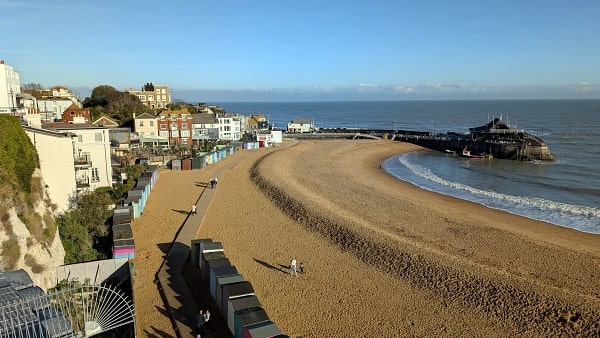
Broadstairs beach
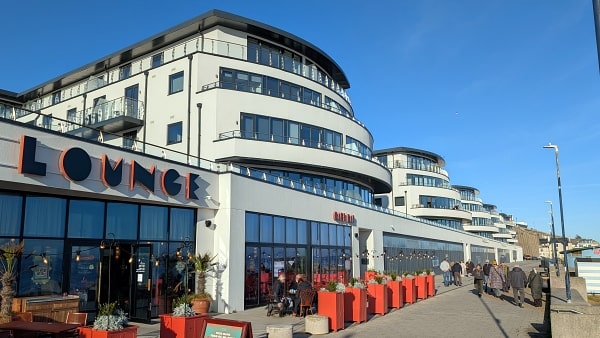
Ramsgate prom
Finally, beyond the village of Pegwell, the chalk peters out. The next settlement is called Cliff’s End for a reason. There’s a replica Viking longship here, sailed across from Denmark in 1949, commemorating the landing of Saxon chiefs Hengist and Horsa 1500 years before, in what would have been one of the first concerted migrations from continental Europe post the Roman withdrawal.
There’s marshland for a bit, before what seems like a permanent diversion away from Richborough Port, to ‘prevent disturbance to commercial activities’, according to signage. Well, either the ECP goes through the port or it doesn’t. ‘Commercial activities’ would have been there when the route was instituted. What the walker gets is a mile diversion by the dual carriageway A256, busy with heavy freight traffic, and then a road past a ‘renewable energy’ power station – loads of trees piled up, ready to burn – and Concept Life Sciences, which may do very important work in drug development but is full of signs warning against photography. Not a great way into Sandwich.
But you get there, by the 14th century Grade 1 listed Fisher Gate. I just had an evening and short morning to look round, but it’s a fine small town, if not the thriving mediaeval port it once was, thanks to the silting of the River Stour.
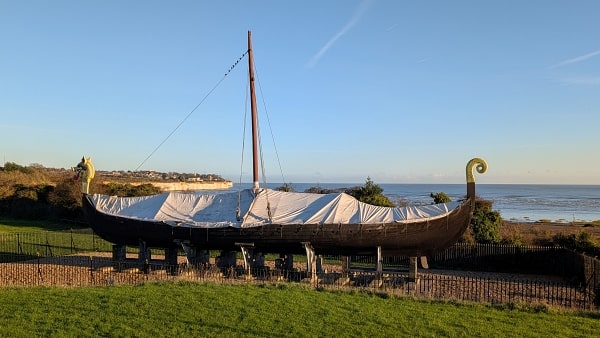
The Hugin at Pegwell
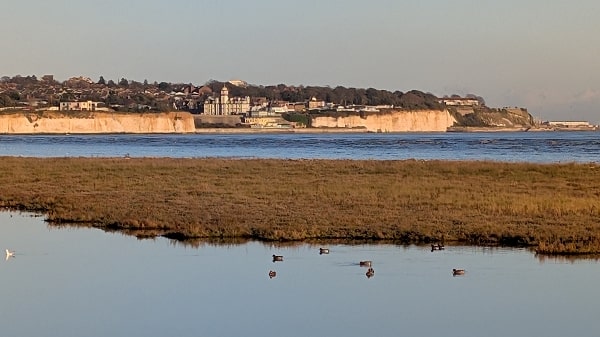
Looking across to Thanet from the marshland
Thursday 27 November 2025. Sandwich to Dover, 20 miles.
Yesterday had been a glorious late-autumn day. The forecast for today was less good, with a stiffening wind likely to be in my face and drizzle more or less on an off all day.
But on waking there was a bit of sun poking through from time to time, so that’s a bonus. And the rain held off until the end.
This walk has three distinct stages. Firstly there are the creeks and dikes by the Stour marshes, before the open sea is reached. Then, all the way through the town of Deal, there is straight-line walking beside (thankfully not on) the shingle beach, all the way to Oldstairs Bay. Then it’s White Cliffs time to the finish at Dover.
Those creeks and dikes are a brief reminder of the Thames marshes of north Kent, though with Concept Life Sciences looming across the Stour. There are no anti-photography signs here, so I took the risk of a quick pic.
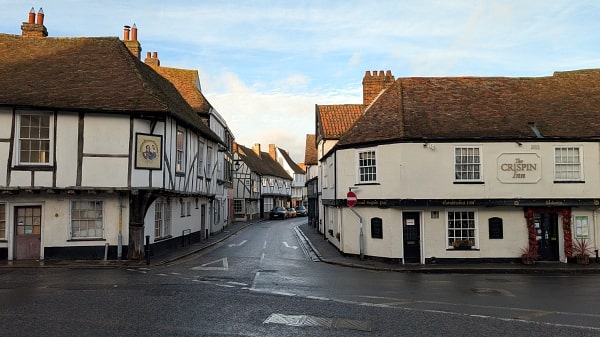
Sandwich
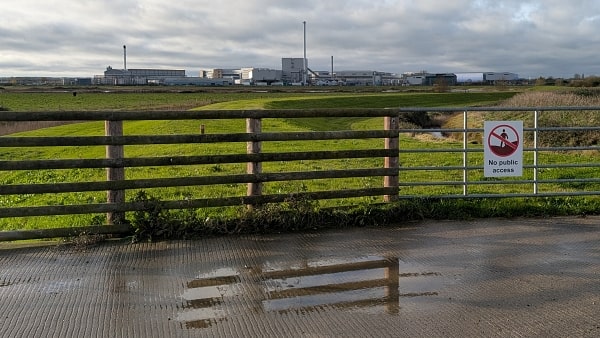
Concept Life Sciences etc
You join the open sea at the top end of Prince’s Golf Club, a progressive beacon in the early 20th century as it welcomed ‘lady golfers’. The signage isn’t clear whether the walker should be on the seaward or golfward side of a fence, but the path was on the latter, so I chose that – a couple of green keepers on a buggy didn’t seem concerned, but there’s a nasty ‘private’ sign at the other end of this stretch.
You then abut the Royal St George’s club. Now, Prince’s is hardly a welcome-to-the-unwashed golf course, but you can turn up most days and play a round, at a price. Royal St George’s is something else. It’s a regular to host the Open Championship, one of the four classic events of the global golfing year. Even in winter, visitors only get a shout on Tuesdays, at twice the price of Prince’s. Jacket and tie for men in the club house after 11am, and ladies to dress ‘so as to complement … the gentlemen’.
There’s a private estate next, then a third golf course, the Royal Cinque Ports. It comes in between the other two fee-wise, but in terms of green-keeping it is to this uneducated watcher the most ravishing, with little bumps and hollows everywhere on the fairways. But Deal isn’t far away now, and it starts at what was once Sandown Castle, one of three Napoleonic-age forts strung along the town. This one now is barely a memory, its stone sold off by the military later in the 19th century.
One of my London LDWA walking colleagues, Rod Smith, has relocated to the town, and I arranged to meet him at a nice little coffee shop just beyond Deal pier.
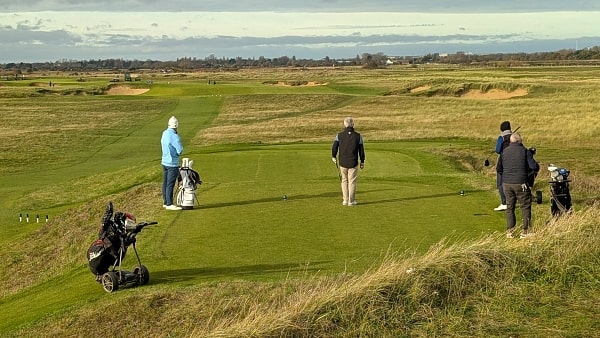
Royal Cinque Ports golf club
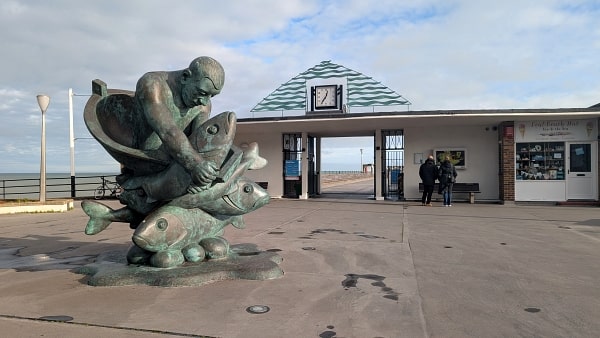
Deal Pier
Rod walks with me for an hour, and I find out something new about the town at every turn (metaphorically, there are few on-the-ground turns). Sample: the Royal Marines were based here for many years, and over there is the site of their swimming pool. Once, several Marines drowned when their boat capsized, and the authorities realised they hadn’t actually been taught to swim. Not a good look. Hence the pool.
All hints of blue sky have long since gone. When Rod turns back home at Oldstairs Bay, where the White Cliffs start, I have a choice. There’s just one village between here and Dover, St Margaret’s at Cliffe, and I’d originally not planned to get beyond there, 16 miles from Sandwich. There’s a bus from it to Dover at 4.45. But it’s only just gone 2, and with just three miles to the village that would mean an awful lot of hanging around in deteriorating weather. On the other hand, Dover is nearly 7 miles and 1500ft of climbing away, and sunset is at 4.
At St Margaret’s it’s barely turning 3, so I commit. It’s really quite unpleasant now, the stiffish wind in my face, misty drizzle most of the time, but I’m moving well and come to recognise that I’m enjoying this harder work more than bimbling along flat surfaces beside golf courses. The path is great too, at least after South Foreland lighthouse, where it’s been improved to be wheelchair-friendly.
And Dover Harbour is soon in view. (Strictly, Dover Eastern Docks; the Western Docks is where trains used to meet ferries.) I marvel at the skill of a ferry crew manoeuvring their craft through the narrow opening of the Dover breakwaters in these conditions, but all of them will have sailed in far worse. It all looks quite dramatic, this busy place of exit / entrance, over the centuries a key to Britain’s sense of itself, both a place of connection and separation.
Finally, down to Dover’s shore, and into town for beer and pizza before the train home.
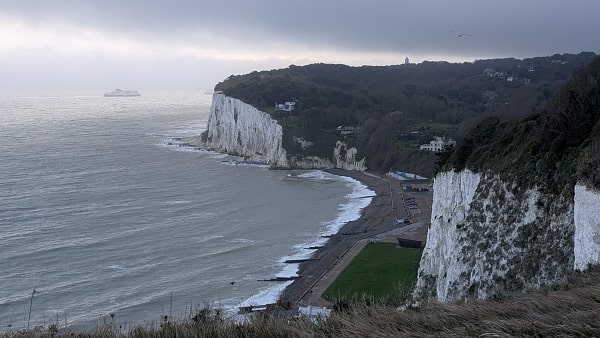
The bay at St Margaret’s at Cliffe
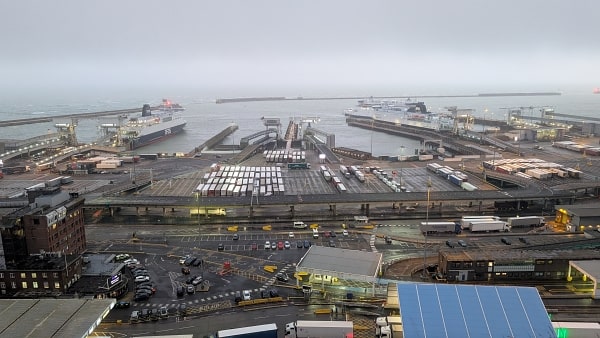
Dover Eastern Docks